
Hear Directly From California Home owners
Myrna and Doug Comstock
Clients
What concerns, hopes, or expectations did you have at the beginning of the process?
As you started working with Reverse Your Thinking, what were you hoping would happen, and how did your actual experience compare to those expectations?
Don Martin
Financial Advisor
Tell us about your experience working with Mathius Gertz and his team.
How did Mathius and his team guide you through the process, and what stood out to you about their professionalism, communication, and support?
Pam and Ivan Cordero
Clients
How has your life changed since completing your reverse mortgage?
What does your financial situation—and perhaps your peace of mind—look like today as a result of working with Reverse Your Thinking?
Larry Schechter
Financial Advisor
What would you say to another senior who is considering a reverse mortgage but feels uncertain or skeptical?
The client is speaking directly to someone in the same situation they once faced.
Mary Martin
Client
Ms. Mary Martin has worked in education for 50 years—first as a teacher and, for the past 20 years, as both a teacher and administrator of her own school for at-risk youth in Compton, California. When a multimillion-dollar loan came due, she feared losing her school. Listen as she shares how Marc Gertz and ReverseYourThinking.Mortgage creatively saved the day with a negative amortization loan that created cash flow and gave her time to reorganize.

Why Are Many People Fearful of Reverse Mortgages?
Since the 1930s, when President Roosevelt was in office, Congress has passed a never-ending series of social legislation. These laws benefited the middle and lower economic classes. The one piece of legislation passed back then that most people remember was the Social Security Act of 1935. At that time, they promised that social security would “solve senior poverty.”
By 1955, Congress knew that social security was in financial trouble to accomplish that goal. So working with the IRS, they passed laws to help induce Americans to save for retirement and supplement what little they would get from social security. That is where IRA, Keogh, SEP, and 401k plans come from, which have a favorable impression in most Americans’ minds.
Home Equity Conversion Mortgage (HECM) programs were another part of that ongoing federal social legislation. But the HECM program suffers from a mixed reputation. Why?
Some mortgage companies in the 1960s came up with an idea for a new type of loan they called a reverse mortgage.
Under their plan, you signed over the title to your home to the lender. The lender would allow you to live in your home for the rest of your life. While they would make your mortgage payments for you and pay you an income per month for your life. Then, when you and your spouse passed away, the lender owned the house. This program was a good solution for some people with not enough income to live on; however, there was a problem.
Starting in the mid-1970s, these reverse mortgage homeowners began to pass away, and that’s when many of their grown children found out for the first time that they weren’t going to inherit the home.
call us today
310-447-5266

OVER
YEARS OF EXPERIENCE
There were several newspaper articles about the turmoil. Mistreatment of seniors, or elder abuse, was the subject of many articles by columnists like Ann Landers. There were several lawsuits, investigations, congressional hearings, and lots of bad press. By the early 1980s, these so-called “reverse loans” had all but vanished.
However, an entire generation, the Baby Boomers and their children, now believed that anything called a reverse mortgage was terrible. But the only thing those programs from the 1960s have in common with the current programs, which didn’t become permanent until 1998, is the same nickname, reverse mortgage. Otherwise, they have nothing in common with one another.
It is important to remember that HECM loans are a piece of federal social legislation like IRA, Keogh, and 401k plans that private companies administer. HECMs were signed into law in 1988 and became permanent in 1998. They are just another tool to help in retirement planning.

Reverse Your Thinking® About Reverse Mortgages
You’ve spent a lifetime building a home. A reverse mortgage shouldn’t put that at risk, and the right one doesn’t. With a modern reverse mortgage, you keep the title to your home. It’s yours, and it stays yours.
You don’t have to figure this out alone or call 10 different lenders hoping one of them tells you the truth. Marc is your California guide, an independent broker who already compared programs, so you don’t have to, and he’ll always tell you exactly where you stand.
Talk to a real specialist, not a call center. Get your free, no-pressure consultation. or take the 2-minute self-evaluation.
call us today
310-447-5266
why choose us
Personalized One-on-One Guidance

Multiple Lending Options

California Reverse Mortgage Expert

Honest Education First

One specialist vs. a dozen lenders:
It’s Your Choice
California is the biggest reverse mortgage market in the country. Most reverse mortgage lenders California homeowners run into are national call-center operations who don’t know your name, neighborhood, or situation. Marc Gertz built his practice to be the opposite of that.
As an independent broker, Marc works with roughly a dozen reverse mortgage lenders and 15 different program types, including Home Equity Conversion Mortgage (HECM), Jumbo, Proprietary, and HELOC Reverse Hybrids. Some options start as early as age 45. That means instead of one company’s product, you get a specialist who compares them all and recommends what actually fits your life.
It also means Marc can say no. If a reverse mortgage isn’t the right tool for your situation, he’ll tell you and point you toward someone who can help, whether that’s a financial planner, an attorney, or another loan program entirely. Attorneys, CPAs, and financial advisors refer their own clients to Marc because they trust him with their clients.
One specialist. Every option. No pressure, no script, no call center.
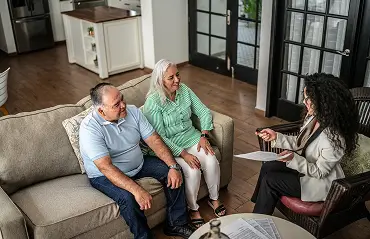





Meet Mathius M. “Marc” Gertz
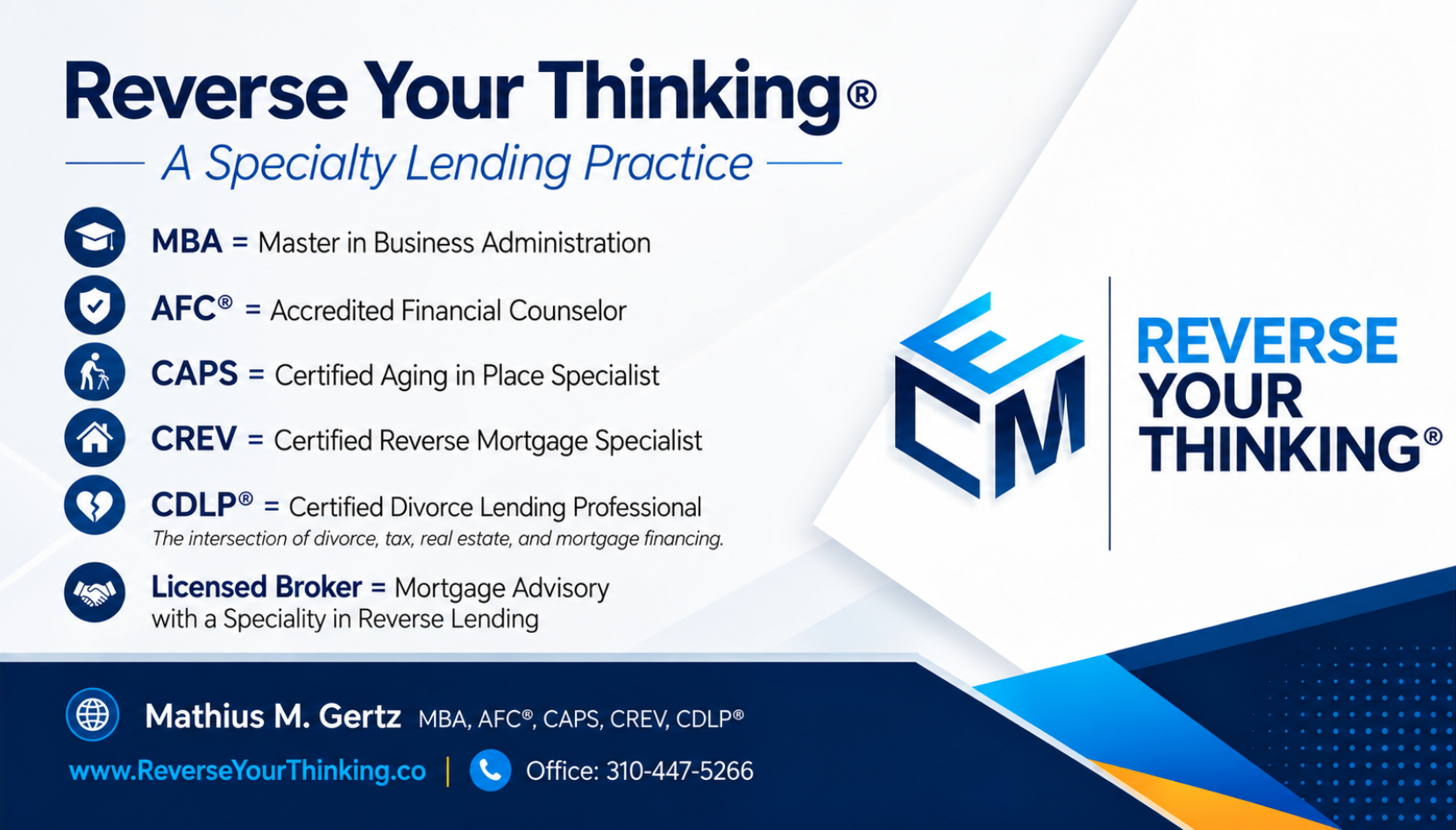
Mathius is a mortgage broker with Reverse Your Thinking®, based in Los Angeles County. He holds an MBA and is an Accredited Financial Counselor (AFC®), Certified Aging in Place Specialist (CAPS), Certified Reverse Mortgage Specialist (CREV), and Certified Divorce Lending Professional (CDLP®).
Marc built his practice around a simple idea: collaborate, educate, problem-solve.
As an independent broker working across roughly a dozen lenders, he offers both lender-sponsored programs and fee-based counseling. Marc works closely with each client’s own attorney, financial planner, or CPA to make sure a reverse mortgage actually fits their bigger plan, not the other way around.
Marc has spent his career explaining complicated financial tools patiently, honestly, and in plain English. always considering the whole family’s peace of mind.

Reverse Your Thinking in Action
Fact vs. Fiction
Many people who remember the 1970s articles about reverse mortgages think that the current HECM program is the same. That couldn’t be further from the truth. Because the private mortgage product from the 1960s and the current federal government-designed program that became permanent in 1998 have the same nickname, the facts and differences are frequently confused. So what do we do? How do reverse mortgages work?
Well… some of you may remember that before the television show LAW AND ORDER, there was the TV show DRAGNET. The Sergeant, Joe Friday, frequently implored female informants to provide “Just the facts, ma’am.” So, before you read any further, let’s separate the facts from the fiction about reverse mortgages?

Fiction:
With a reverse mortgage, you are selling your house to the bank, and the house has to be free and clear to qualify.
fact:
Homeowners never give up title or ownership of their homes, and most homeowners use loan proceeds to pay off an existing loan on their primary residence.

Fiction:
Reverse mortgages are costly and have high closing and origination fees.
fact:
Interest rates are comparable to conventional FHA rates, and fees vary by lender. Sometimes there are virtually no closing costs, with one exception — an insurance fee unique to a HECM that guarantees this is a non-recourse loan. There are different types of reverse mortgages, ranging from traditional HECM loans to proprietary reverse mortgages like jumbo reverse. Our company works with twelve different reverse companies with fifteen different reverse-style programs to design the best programs to solve your problems.

Fiction:
If the home loan balance grows bigger than the home value, the borrower is on the hook for the difference.
fact:
All reverse mortgages are non-recourse loans, and a borrower, the estate, the children, or the trust will never owe the lender more than the current value of the home. The current design of these loans is that there are substantial assets for inheritance from the family home after the homeowners die or if they decide to sell the home while still alive and downsize.

Fiction:
All reverse mortgage funds you receive need to be explained, justified, and approved for use by the lender, the FHA, and HUD.
fact:
There are no restrictions, approvals, explanations, or reporting required. Funds may be used for any purpose, at will, without justification from any government agency. Currently, all types of reverse loan proceeds are received tax-free and do not need to be claimed on your tax returns.

Fiction:
I will lose my government assistance if I get a reverse mortgage.
fact:
A reverse mortgage does not affect regular Social Security or Medicare/Medi-Cal benefits. However, if you are on Medicaid, Medi-Cal, or SSI, any reverse mortgage funds you receive should be spent within the same calendar month.

Fiction:
Reverse mortgages are a loan of last resort — only for people in desperate financial conditions.
fact:
Many people use a HECM Line of Credit as a safety net to draw on in an emergency. Reverse loans are now used in sophisticated retirement planning and asset protection — a hedge against a bear stock market or housing downturn, or to delay taking Social Security until age 70.

Fiction:
There are few differences between a HECMLOC and a HELOC.
fact:
They are entirely different, except that both use your home as collateral. Once in place, a reverse line of credit is no longer tied to the value of your home — the lender cannot call, cancel, or reduce it even if your home’s value decreases.
Let us separate fact from fiction and Reverse Your Thinking® about reverse mortgages!
what a reverse mortgage is / can do
If you’re looking for ways to supplement your retirement income or access your home equity with a Reverse Mortgage, Federal Housing administration (FHA) insured reverse mortgage loan may be the answer. A reverse mortgage loan allows you to access a portion of your home’s equity to obtain tax-free funds without having to make monthly mortgage payments.
CLIENT TESTIMONIALS
What our clients say about us
Knowledgeable, friendly, experienced, service oriented, problem solving, ethical... there are not enough superlatives to talk about Marc Gertz and Reverse. If there is EVER a need or question, Marc is...
Eric Brown, Realtor

Marc Gertz made the process easy and extremely efficient.
Eva Chimento
Marc Gertz of Reverse is a great resource of information on reverse mortgages. His ability to easily explain what a reverse mortgage is (and is not), helps homeowners age 62+...
Monica Higgins
frequently
asked questions
Will my kids inherit my debt if I get a reverse mortgage?
No. Every reverse mortgage today is non-recourse. That means you, your estate, and your heirs will never owe more than the home is worth even if in a rare instance the loan balance grows larger than the home’s value. When the home is eventually sold, any remaining equity still belongs to your family.
Do I still own my home?
Yes. You keep the title to your home for as long as you live there, just as you would with a traditional mortgage. The most common misunderstanding about reverse mortgages comes from a very different product. That product hasn’t existed in decades. Ask us about the history if you want the full story. The short version is that today’s HECM program is federally regulated, and your name stays on the title.
What if a reverse mortgage isn’t right for me?
Then we’ll tell you. Marc’s practice is built on saying no when a reverse mortgage doesn’t fit. Instead, he can point you toward whatever does, whether that’s a different loan program or a conversation with your own financial planner or attorney. Our job is to fit the tool to your life, not the other way around.
What ongoing costs am I responsible for?
You’ll still need to pay property taxes, keep homeowners insurance current, pay HOA fees, and maintain the home. Beyond that, there’s no required monthly mortgage payment.
Am I too young or too old to qualify for a reverse mortgage?
The standard HECM program is available starting at age 62. Some proprietary and jumbo reverse programs open the door as early as age 55, and there’s no upper age limit. A quick conversation is the easiest way to find out if you are age eligible. There are also now hybrid HELOC reverse programs available that start even younger (below 55).
Do I have to go through a lender directly, or can I compare options?
You can and should compare options. As an independent broker, Marc works with roughly a dozen reverse mortgage lenders California homeowners can choose from, across 15 program types. Instead of a single company’s product, you get a side-by-side look at what’s actually available for your home and your goals.
Is counseling really required?
Yes, it is required and that’s a good thing. Before closing on a HECM, you’ll complete a session with a HUD-approved independent counselor. It’s a consumer protection built into the program, not a sales step, and it’s there to make sure you understand exactly what you’re agreeing to before you sign the papers.

serving homeowners
across California
Marc’s backyard is Southern California — Los Angeles, Santa Monica, Beverly Hills, Inglewood, and the surrounding communities — but he works with homeowners across the entire state. Whether you’re in a coastal condo or an inland ranch house, the process is the same. It starts with a real conversation, real numbers, and a plan built around your home and your life.
No two California markets look alike, and neither do the homeowners in them, which is why every conversation starts with your specific home, county, and goals, not a script.

